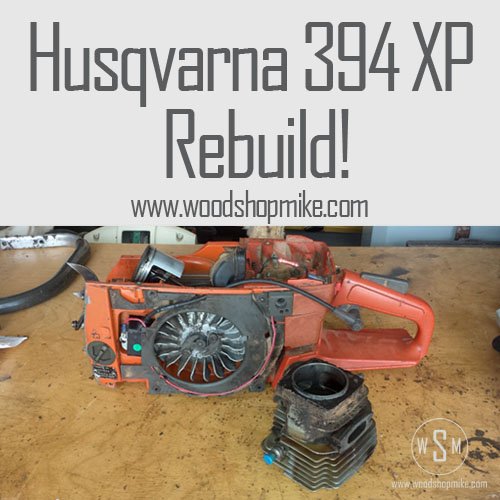
Why would anyone rebuild a Husqvarna 394 XP in the age of electric chainsaws?
It’s a question I hear a lot, usually from folks who’ve never wrestled with a truly professional-grade, gas-powered saw. The short answer? Because a properly rebuilt 394 XP is a beast, a legend, a tool that simply doesn’t have a modern equivalent in terms of raw, unadulterated power and longevity for serious arborists and loggers. We’re not talking about trimming a few branches here; we’re discussing felling mature hardwoods or bucking massive logs where battery life is a distant, irrelevant concern. Some of these saws, with proper care, can outlast their owners. When mine finally started showing its age after nearly two decades of hard use, the thought of replacing it with something disposable felt… wrong. It was a serious investment back then, and frankly, it still outperforms many newer, less robust models. Many people underestimate the economic sense of restoration over replacement, especially for tools designed for extreme durability.
What exactly goes into a Husqvarna 394 XP rebuild?
A full rebuild is more than just a quick tune-up; it’s a systematic overhaul of the engine and all its supporting components. This typically starts with a complete teardown of the powerhead. Every screw, every washer, every gasket is removed. The cylinder is inspected for scoring; if damage is present, it’s often replaced or re-plated. The piston rings are replaced as a matter of course, as are all seals and gaskets. We’re talking crankshaft seals, intake manifold gaskets, exhaust gaskets, clutch cover seals – the works. Bearings, both crankshaft and possibly countershaft bearings depending on the specific model iteration and wear, are replaced. The carburetor gets a full rebuild kit, ensuring precise fuel-air mixture. Then comes the ignition system: the coil is checked, and the spark plug is always replaced. The muffler might be cleaned or replaced if performance is compromised. It’s a deep dive, essentially giving the saw a new lease on life, often exceeding the performance of a factory-fresh, mass-produced unit from less specialized manufacturers.
How can you tell if your 394 XP needs a rebuild versus routine maintenance?
The signs are usually quite distinct, and often dramatic. If your saw is struggling to start, particularly when hot, or if it starts but won’t stay running without the choke partially engaged, that’s a big red flag. A significant loss of power, even after you’ve cleaned the air filter, checked the spark arrestor screen, and ensured the chain is sharp and properly tensioned, points towards internal engine issues. Excessive smoke from the exhaust, especially a bluish tint that indicates oil is burning excessively, or a metallic rattling sound from the crankcase, are also strong indicators. I’ve seen saws where the idle speed is so erratic it sounds like a sputtering lawnmower, or where they simply die when you blip the throttle. These aren’t minor adjustments; they signal internal wear or component failure. For instance, a worn crankshaft seal can cause fuel to leak into the crankcase, leading to poor running and, eventually, catastrophic engine failure – that’s definitely beyond routine maintenance.
Who benefits most from investing time and money into a 394 XP rebuild?
The primary beneficiaries are professionals who rely on their equipment for their livelihood: arborists, loggers, and serious landowners who tackle significant tree removal or firewood processing. These individuals understand that downtime is lost income. A rebuilt 394 XP offers the kind of brute force needed for felling large trees, something smaller saws simply can’t handle efficiently or safely. They appreciate the durability and the repairability. A colleague once told me he’d rather have one properly maintained, powerful older saw than three mediocre new ones. For them, the cost of a rebuild, which can range from a few hundred dollars for a DIY job to over $600-$800 for a professional overhaul, is a fraction of the cost of a new professional saw of comparable capability – if such a thing even truly exists anymore. Enthusiasts who appreciate vintage, high-performance machinery also find immense satisfaction in restoring these iconic saws.
What are the potential pitfalls or challenges during a 394 XP rebuild?
The biggest challenge, especially for DIYers, is ensuring you have the correct parts and the right tools. Husqvarna has used various iterations of the 394 XP over the years, and sourcing specific gaskets, seals, or even piston/cylinder kits for older models can be tricky. You absolutely need a good service manual; trying to wing it is a recipe for disaster. Torque specifications are critical, especially for the crankcase bolts and cylinder head. Overtightening can strip threads or crack the magnesium casing, while undertightening can lead to air leaks and poor performance. Another common pitfall is improper reassembly, like misaligning the crankshaft bearings or pinching a seal. I once spent an entire weekend chasing a phantom air leak on a rebuild, only to discover I’d slightly nicked a crankshaft seal during installation. That tiny imperfection was enough to make the saw run like a dog. Also, cleaning every single passageway in the crankcase and carburetor is non-negotiable; a single speck of old gasket material can clog a vital oil or fuel port.
When is it actually more cost-effective to replace a Husqvarna 394 XP rather than rebuild it?
This is where keen assessment comes into play. If the crankcase itself is cracked beyond repair – a rare but possible scenario from a severe drop or improper reassembly – the cost of a replacement case, plus all the parts for a full rebuild, can quickly exceed the price of a decent used professional saw. Similarly, if the cylinder bore is heavily scored and no longer serviceable, and you can’t find an affordable replacement cylinder/piston kit, it might be time to reconsider. Another factor is the overall condition of the magnesium alloy body. If it’s heavily corroded or has suffered significant physical damage, restoration becomes less practical. A rough rule of thumb I use: if the cost of parts and labor (or your time, if DIYing) approaches 70-80% of the price of a comparable new saw, then replacement starts to look more appealing. However, given that a new professional saw with the 394 XP’s displacement and power output often costs well over $1000-$1500 (think Stihl MS462 R C-M or a Husqvarna 572 XP), a $600 rebuild still represents significant savings, provided the core components are sound.
Could a rebuilt 394 XP outperform a brand-new, modern chainsaw in specific tasks?
In certain applications, absolutely. The 394 XP, with its displacement often around 92cc, offers a torque profile that many newer, albeit lighter and more nimble, saws struggle to match. For instance, when bucking thick, dense hardwoods, the sheer lugging power of a well-tuned 394 XP can prevent the chain from bogging down where a smaller saw would stall. I’ve personally experienced this when cutting through oak logs that felt like solid iron; the 394 just kept chewing through them. Modern saws often achieve higher RPMs, which is great for limbing and general use, but that raw torque is what a rebuilt 394 XP brings back to the table. It’s a different kind of performance – less about speed, more about relentless power delivery under load. While a new saw might be lighter and have features like anti-vibration or heated handles, the core cutting ability of a restored 394 XP in demanding situations is, in my experience, often superior for those who know how to handle it. Think of it like comparing a highly tuned V8 muscle car to a modern, efficient sports sedan; both are fast, but they deliver their performance in fundamentally different ways. The muscle car’s brutal, immediate torque is its defining characteristic, much like the 394 XP’s relentless pull.
The future for these legendary machines isn’t necessarily obsolescence. As manufacturers continue to simplify designs for mass production and incorporate more electronics, the demand for robust, repairable, and powerful older models like the 394 XP only seems to grow among those who truly push their equipment to the limit. It’s a testament to Swedish engineering. Perhaps we’ll see a resurgence in specialized rebuilders offering factory-quality restorations, ensuring these powerhouses continue to fell trees for decades to come.
